
Intelligence, Decoded and Designed
Spotlights




Our Roots
Center for Brains, Minds, and Machines
Missions + Platforms
To understand intelligence, the Quest fosters and funds research Missions, which are supported by Platforms.
-
Brain-Score
The Brain-Score platform aims to yield accurate, machine-executable computational models of how the brain gives rise to the mind. Read More
-
Perceptual Intelligence
The Perceptual Intelligence mission aims to produce machine executable models of human visual intelligence. Read More
-
Embodied Intelligence
The Embodied Intelligence mission addresses how we perceive the world around us and integrate this information to plan and complete tasks. Read More
-
The Development of Intelligent Minds
This mission aims to understand how children grasp new concepts and build upon layers of concepts to reach an understanding of the world. Read More
-
Cognitive Compute
The Scaling Inference team pursues an alternate scaling route for AI systems and for human intelligence models, based on inference in probabilistic programs. Read More
-
Intelligence Observatory
The Intelligence Observatory is a human behavioral testing and benchmarking platform. Read More
-
Language and Thought
The Language and Thought mission aims to understand the relationship between language and human intelligence. Read More




News
-
Recent news from SQI: June 2026
In June, once we've said goodbye to the graduates and their families, we look at what we've accomplished over the past year and start planning for the months ahead.
-
How Do Children Reason About Cause and Effect?
Children as young as three years old already have a strong understanding of abstract causality, but new data shows that they may be less advanced when it comes to understanding the mechanisms involved in cause-and-effect scenarios.
-
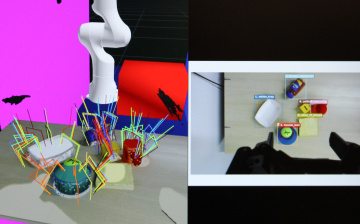
Robots That Think Before They Act
The TiPToP system enables robots to reason in order to plan and complete tasks using spatial modeling and plain-language task instructions.